Conficker worm is the most widespread worm in today's date. It has been making news since last few weeks.
This worm is one of the most deadly worm which attacks your network and modify your system settings. It gets launched automatically at system startup and stays in memory in stealth mode to prevent its detection. It spreads itself through pen drives, network holes and it also features a method of cracking administrator password.
Almost all the antivirus vendors have released separate tools to remove the worm. These standalone programs do not require any installation. Just download, unzip/extract if required and then run on the infected PC.
There are lot of tools available on web which can remove various versions of Conficker aka Downadup aka Kido worm.
Some Conficker Removal or Deletion tools are as follows:
1. Avert Stinger Standalone tool from McAfee
2. F-Secure Worm:W32/Downadup.AL Removal Tool from F-Secure
3. Symantec W32.Downadup Removal Tool from Symantec
4. Conficker Single PC Removal Tool from Bitdefender
5. Conficker Network Removal Tool from Bitdefender
You can download any of the above tools to remove conficker or downadup or kiddo virus from your computer safely. Leave a comment if none to the above tools works for you.
Showing posts with label Must Read. Show all posts
Showing posts with label Must Read. Show all posts
Thursday, April 2, 2009

Sunday, February 1, 2009
Rs 500 laptop display on Feb 3
NEW DELHI: A $10 laptop (Rs 500) prototype, with 2 GB RAM capacity, would be on display in Tirupati on February 3 when the National Mission on
Education through Information and Communication Techology is launched.
The $10 laptop project, first reported in TOI three years ago, has come as an answer to the $100 laptop of MIT's Nicholas Negroponte that he was trying to hardsell to India. The $10 laptop has come out of the drawing board stage due to work put in by students of Vellore Institute of Technology, scientists in Indian Institute of Science, Bangalore, IIT-Madras and involvement of PSUs like Semiconductor Complex. “At this stage, the price is working out to be $20 but with mass production it is bound to come down,” R P Agarwal, secretary, higher education said.
Apart from questioning the technology of $100 laptops, the main reason for HRD ministry's resistance to Negroponte's One Laptop Per Child (OLPC) project was the high and the hidden cost that worked out to be $200.
The mission launch would also see demonstration of e-classroom, virtual laboratory and a better 'Sakshat' portal that was launched more than two years ago. Sources also said that the ministry has entered into an agreement with four publishers — Macmillan, Tata McGraw Hill, Prentice-Hall and Vikas Publishing — to upload their textbooks on 'Sakshat'. Five per cent of these books can be accessed free.
The mission, with an 11th plan outlay of Rs 4,612 crore, is aimed at making a serious intervention in enhancing the Gross Enrolment Ratio in higher education. The mission has two major components. One, content generation through its portal 'Sakshat', and two, building connectivity along with providing access devices for institutions and learners.
In this context, government would give Rs 2.5 lakh per institution for 10 Kbps connection and subsidise 25% of costs for private and state government colleges.
The mission would seek to extend computer infrastructure and connectivity to over 18,000 colleges in the country, including each department of nearly 400 universities and institutions of national importance. The mission would focus on appropriate e-learning procedures, providing facility of performing experiments through virtual laboratories, online testing and certification, online availability of teachers to guide and mentor learners, and utilization of EduSat and DTH.
Education through Information and Communication Techology is launched.
The $10 laptop project, first reported in TOI three years ago, has come as an answer to the $100 laptop of MIT's Nicholas Negroponte that he was trying to hardsell to India. The $10 laptop has come out of the drawing board stage due to work put in by students of Vellore Institute of Technology, scientists in Indian Institute of Science, Bangalore, IIT-Madras and involvement of PSUs like Semiconductor Complex. “At this stage, the price is working out to be $20 but with mass production it is bound to come down,” R P Agarwal, secretary, higher education said.
Apart from questioning the technology of $100 laptops, the main reason for HRD ministry's resistance to Negroponte's One Laptop Per Child (OLPC) project was the high and the hidden cost that worked out to be $200.
The mission launch would also see demonstration of e-classroom, virtual laboratory and a better 'Sakshat' portal that was launched more than two years ago. Sources also said that the ministry has entered into an agreement with four publishers — Macmillan, Tata McGraw Hill, Prentice-Hall and Vikas Publishing — to upload their textbooks on 'Sakshat'. Five per cent of these books can be accessed free.
The mission, with an 11th plan outlay of Rs 4,612 crore, is aimed at making a serious intervention in enhancing the Gross Enrolment Ratio in higher education. The mission has two major components. One, content generation through its portal 'Sakshat', and two, building connectivity along with providing access devices for institutions and learners.
In this context, government would give Rs 2.5 lakh per institution for 10 Kbps connection and subsidise 25% of costs for private and state government colleges.
The mission would seek to extend computer infrastructure and connectivity to over 18,000 colleges in the country, including each department of nearly 400 universities and institutions of national importance. The mission would focus on appropriate e-learning procedures, providing facility of performing experiments through virtual laboratories, online testing and certification, online availability of teachers to guide and mentor learners, and utilization of EduSat and DTH.
Monday, January 5, 2009
The Future of Your PC's Hardware - Memristor: A Groundbreaking New Circuit
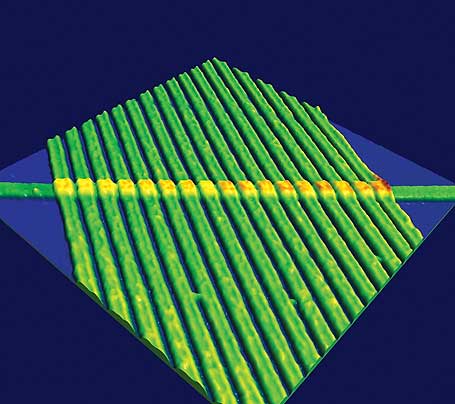
Since the dawn of electronics, we've had only three types of circuit components--resistors, inductors, and capacitors. But in 1971, UC Berkeley researcher Leon Chua theorized the possibility of a fourth type of component, one that would be able to measure the flow of electric current: the memristor. Now, just 37 years later, Hewlett-Packard has built one.
What is it? As its name implies, the memristor can "remember" how much current has passed through it. And by alternating the amount of current that passes through it, a memristor can also become a one-element circuit component with unique properties. Most notably, it can save its electronic state even when the current is turned off, making it a great candidate to replace today's flash memory.
Memristors will theoretically be cheaper and far faster than flash memory, and allow far greater memory densities. They could also replace RAM chips as we know them, so that, after you turn off your computer, it will remember exactly what it was doing when you turn it back on, and return to work instantly. This lowering of cost and consolidating of components may lead to affordable, solid-state computers that fit in your pocket and run many times faster than today's PCs.
Someday the memristor could spawn a whole new type of computer, thanks to its ability to remember a range of electrical states rather than the simplistic "on" and "off" states that today's digital processors recognize. By working with a dynamic range of data states in an analog mode, memristor-based computers could be capable of far more complex tasks than just shuttling ones and zeroes around.
When is it coming? Researchers say that no real barrier prevents implementing the memristor in circuitry immediately. But it's up to the business side to push products through to commercial reality. Memristors made to replace flash memory (at a lower cost and lower power consumption) will likely appear first; HP's goal is to offer them by 2012. Beyond that, memristors will likely replace both DRAM and hard disks in the 2014-to-2016 time frame. As for memristor-based analog computers, that step may take 20-plus years.
Saturday, January 3, 2009
BSNL, Novatium roll out low-cost computer
‘Nova netPC’ is available in two packages of Rs.1,999 and Rs.2,999
Bharat Sanchar Nigam Limited (BSNL) and Chennai-based IT solutions company Novatium on Friday rolled out a low-cost home computing device that could help the former achieve a target of 9 million broadband connections across the country in the next couple of years.
At a press conference after the launch of “Nova netPC” on the BSNL’s network, Chairman and Managing Director of BSNL Kuldeep Goyal said affordability issues over buying a desktop PC or laptop would no longer stand in the way of broadband penetration, especially in rural areas.
Essentially, the user is provided with a set top box, keyboard and mouse while most hardware functions of a computer will be managed by a central server. Most of the widely used applications will be available to the user. The central server will facilitate access to the BSNL’s broadband conduit, for which the user will need to subscribe to any of the DataOne monthly plans.
Nova netPC, available in two packages (down payment of Rs.1,999 and a monthly charge of Rs.199, and an upfront fee of Rs.2,999 and monthly subscription of Rs.175), is available at BSNL’s outlets in the city.
Mr. Goyal said the total number of broadband users in the country was only 5.25 million, which was less than 1 per cent of the population. In developed societies, the penetration levels were as high as 60 per cent or more.
BSNL aimed to account for about 60 per cent of the 20 million broadband connections stipulated as target for 2010 by the government. BSNL, which now has 3 million broadband users, has equipped at a cost of Rs.1,600 crore 23,000 of its network of 30,000 telephone exchanges for broadband connectivity. BSNL enjoyed a 56 per cent market share in the broadband space, he pointed out.
“Negotiations with the Universal Service Obligation Fund, a body mandated with scaling up rural telephony, are in an advanced stage on providing near-free broadband tariffs and subsidised customer end equipment for rural users,” he said.
3G technology
BSNL’s plans for the immediate future include rollout of 3G technology on its GSM network (the national launch planned from Chennai now has been rescheduled to February), providing broadband on optic fibre for high-end users and facilitating wireless broadband (WiMAX) in 1,000 rural blocks.
Advance purchase orders for WiMAX equipment had been placed with suppliers.
Novatium CEO Alok Singh said the link-up with BSNL fitted in with the company’s vision of making computing simple and affordable and taking broadband to the nook and corner of the country.
The netPC, which is protected with 11 global patents, had been around for over a year in Delhi and would shortly go commercial. In addition to 1,000 users in the capital, the netPC had been launched in Mauritius. In Chennai, where BSNL issued 8,000 new connections a month, Novatium targeted a sale of 1,000 units by January end.
Post-launch, Nova netPC devices were distributed to four BSNL customers.
Bharat Sanchar Nigam Limited (BSNL) and Chennai-based IT solutions company Novatium on Friday rolled out a low-cost home computing device that could help the former achieve a target of 9 million broadband connections across the country in the next couple of years.
At a press conference after the launch of “Nova netPC” on the BSNL’s network, Chairman and Managing Director of BSNL Kuldeep Goyal said affordability issues over buying a desktop PC or laptop would no longer stand in the way of broadband penetration, especially in rural areas.
Essentially, the user is provided with a set top box, keyboard and mouse while most hardware functions of a computer will be managed by a central server. Most of the widely used applications will be available to the user. The central server will facilitate access to the BSNL’s broadband conduit, for which the user will need to subscribe to any of the DataOne monthly plans.
Nova netPC, available in two packages (down payment of Rs.1,999 and a monthly charge of Rs.199, and an upfront fee of Rs.2,999 and monthly subscription of Rs.175), is available at BSNL’s outlets in the city.
Mr. Goyal said the total number of broadband users in the country was only 5.25 million, which was less than 1 per cent of the population. In developed societies, the penetration levels were as high as 60 per cent or more.
BSNL aimed to account for about 60 per cent of the 20 million broadband connections stipulated as target for 2010 by the government. BSNL, which now has 3 million broadband users, has equipped at a cost of Rs.1,600 crore 23,000 of its network of 30,000 telephone exchanges for broadband connectivity. BSNL enjoyed a 56 per cent market share in the broadband space, he pointed out.
“Negotiations with the Universal Service Obligation Fund, a body mandated with scaling up rural telephony, are in an advanced stage on providing near-free broadband tariffs and subsidised customer end equipment for rural users,” he said.
3G technology
BSNL’s plans for the immediate future include rollout of 3G technology on its GSM network (the national launch planned from Chennai now has been rescheduled to February), providing broadband on optic fibre for high-end users and facilitating wireless broadband (WiMAX) in 1,000 rural blocks.
Advance purchase orders for WiMAX equipment had been placed with suppliers.
Novatium CEO Alok Singh said the link-up with BSNL fitted in with the company’s vision of making computing simple and affordable and taking broadband to the nook and corner of the country.
The netPC, which is protected with 11 global patents, had been around for over a year in Delhi and would shortly go commercial. In addition to 1,000 users in the capital, the netPC had been launched in Mauritius. In Chennai, where BSNL issued 8,000 new connections a month, Novatium targeted a sale of 1,000 units by January end.
Post-launch, Nova netPC devices were distributed to four BSNL customers.
Monday, June 16, 2008
Energy calculator for computers
There are online energy calculators available on the internet such as the Extreme power supply calculator. All you have to do is punch in the detailed configuration of your PC or laptop and click the calculate button. The aggregate of power consumed by all the components is displayed.
Link:- Extreme power supply calculator
Link:- Extreme power supply calculator
Thursday, June 12, 2008
Israeli co invents see through device
Military and rescue operations around the globe will now get a tad easier with the invention of a radar that can see through walls. An Israeli firm, Camero, has developed this technology and already sold it to several army and police forces. The company feels that the device can be beneficial for special unit soldiers or for human operations like locating people trapped in burning buildings, the daily Haaretz reported.
"The idea of seeing through walls has been around since the 1960s, but modern technology is now ripe enough to enable it to happen," Camero's technology director Amir Beeri said. "When we established the company in 2004, we intended to develop sufficiently high vision resolution to allow an untrained user to see through a wall," Beeri said.
Camero's unique radar utilises Ultra Wide Band (UWB), a technology that has come of age recently and with the use of special algorithms can process data picked up by the detector to give a reasonable image of anything behind the wall.
The system made by its competitor, Time Domain, lacks imaging algorithms and is able to reveal only whether there is someone on the other side of the wall, the report said.
The firm's earlier version of the system weighed about 10 kgs and was too clumsy for use, but the new system is smaller, light in weight and meant for use as a quick-to-use tactical tool. The system is capable of penetrating various types of walls, but not solid metal ones like the walls of shipping containers.
The firm's CEO, Aharon Aharon, is optimistic about the future of the technology and says, "Like the Israeli army's night vision system, which was once an expensive product and eventually came into broad, general use, we hope that our radar too will become standard issue for all military units."
Subscribe to:
Comments (Atom)
-
Rediff.com has introduced a toolbar for Firefox 3. The new toolbar allows users to search the Web and access popular vertical searches for f...
-
What is G Suite? G Suite is a cloud-based productivity suite that helps teams communicate, collaborate and get things done from anywher...
-
Internet Explorer 7 on Windows Click the "Tools" menu Click "Internet Options" Select the "Privacy" tab ...
