The global ecosystem of more than 1,100 technology companies charged with setting interoperable SD standards, SD Association, has developed the next-generation SDXC (eXtended Capacity) memory card specification, which provides up to 2TB (terabytes) massive storage capacity with read/write speeds to 104MB/s this year, aiming to provide users larger capacity and faster transfer speeds for expanded entertainment and data storage.
“SDXC combines a higher capacity roadmap with faster transfer speeds as a means to exploit NAND flash memory technology as a compelling choice for portable memory storage and interoperability,” said Joseph Unsworth, research director, NAND Flash Semiconductors, at Gartner. “With industry support, SDXC presents manufacturers with the opportunity to kindle consumer demand for more advanced handset features and functionality in consumer electronics behind the ubiquitous SD interface.”
“With SDXC, consumers can quickly download higher quality content to their phones, including games, video and music – giving consumers a richer media and content experience,” said James Taylor, president of the SD Association. “The SD interface already has proven itself valuable in mobile phones. Now, SDXC memory card capabilities will spur further handset sophistication and boost consumer content demand.”
“SDXC is a large-capacity card that can store more than 4,000 RAW images, which is the uncompressed mode professionals use, and 17,000 of the fine-mode most consumers use. That capacity, combined with the exFAT file system, increases movie recording time and reduces starting time to improve photo-capturing opportunities,” said Shigeto Kanda, general manager of Canon. “Improvements in interface speed allow further increases in continuous shooting speed and higher resolution movie recordings. As a memory card well suited to small-sized user-friendly digital cameras, the SDXC specification will help consumers realize the full potential of our cameras.”
Wednesday, January 14, 2009

Tuesday, January 6, 2009
Army to launch its own mobile service!
Not one to be left behind, the Indian Army will next month launch its own mobile communication system christened 'Mercury blaze', says a PTI report.
An army spokesperson said the mega project is being handled by the Corps of Signals, who are currently weighing the system in terms of reliability and security, among other parameters.
The project was actually launched in January last year, and is expected to reach completion by end of this month.
Sources familiar with the project said the new system will replace the old wireless communication service used during counter-insurgency operations in the state.
They said that the sophisticated technology would ensure faster mobility of troops during anti-terrorist operations. Besides helping provide the best secured communication to troops, the system would provide data communication directly to operational areas.
The sources added that the system would enhance battlefield transparency, with troops being able to coordinate and carry out counter-insurgency operations in the best possible manner.
The countdown to the launch has begun, with a series of mobile towers and other infrastructure already set up across army formations in the country, including Jammu and Kashmir's Rajouri, Doda, Udhampur, Jammu, and Poonch districts.
It is learnt that the new system was put to the test in the army's Nagrota-based 16 Corps operational area that spreads out from the South of the Pir Panjal range to the Jammu plains. And, the trial emerged error-free and successful, according to sources.
An army spokesperson said the mega project is being handled by the Corps of Signals, who are currently weighing the system in terms of reliability and security, among other parameters.
The project was actually launched in January last year, and is expected to reach completion by end of this month.
Sources familiar with the project said the new system will replace the old wireless communication service used during counter-insurgency operations in the state.
They said that the sophisticated technology would ensure faster mobility of troops during anti-terrorist operations. Besides helping provide the best secured communication to troops, the system would provide data communication directly to operational areas.
The sources added that the system would enhance battlefield transparency, with troops being able to coordinate and carry out counter-insurgency operations in the best possible manner.
The countdown to the launch has begun, with a series of mobile towers and other infrastructure already set up across army formations in the country, including Jammu and Kashmir's Rajouri, Doda, Udhampur, Jammu, and Poonch districts.
It is learnt that the new system was put to the test in the army's Nagrota-based 16 Corps operational area that spreads out from the South of the Pir Panjal range to the Jammu plains. And, the trial emerged error-free and successful, according to sources.
Monday, January 5, 2009
The Future of Your PC's Hardware - Memristor: A Groundbreaking New Circuit
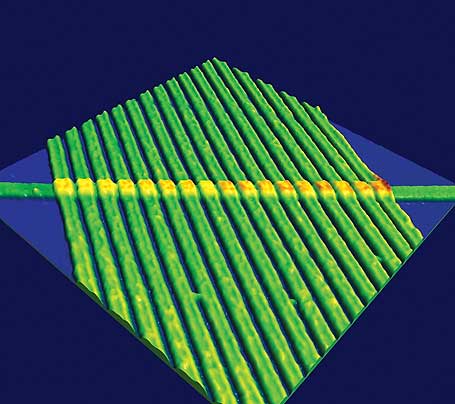
Since the dawn of electronics, we've had only three types of circuit components--resistors, inductors, and capacitors. But in 1971, UC Berkeley researcher Leon Chua theorized the possibility of a fourth type of component, one that would be able to measure the flow of electric current: the memristor. Now, just 37 years later, Hewlett-Packard has built one.
What is it? As its name implies, the memristor can "remember" how much current has passed through it. And by alternating the amount of current that passes through it, a memristor can also become a one-element circuit component with unique properties. Most notably, it can save its electronic state even when the current is turned off, making it a great candidate to replace today's flash memory.
Memristors will theoretically be cheaper and far faster than flash memory, and allow far greater memory densities. They could also replace RAM chips as we know them, so that, after you turn off your computer, it will remember exactly what it was doing when you turn it back on, and return to work instantly. This lowering of cost and consolidating of components may lead to affordable, solid-state computers that fit in your pocket and run many times faster than today's PCs.
Someday the memristor could spawn a whole new type of computer, thanks to its ability to remember a range of electrical states rather than the simplistic "on" and "off" states that today's digital processors recognize. By working with a dynamic range of data states in an analog mode, memristor-based computers could be capable of far more complex tasks than just shuttling ones and zeroes around.
When is it coming? Researchers say that no real barrier prevents implementing the memristor in circuitry immediately. But it's up to the business side to push products through to commercial reality. Memristors made to replace flash memory (at a lower cost and lower power consumption) will likely appear first; HP's goal is to offer them by 2012. Beyond that, memristors will likely replace both DRAM and hard disks in the 2014-to-2016 time frame. As for memristor-based analog computers, that step may take 20-plus years.
Saturday, January 3, 2009
BSNL, Novatium roll out low-cost computer
‘Nova netPC’ is available in two packages of Rs.1,999 and Rs.2,999
Bharat Sanchar Nigam Limited (BSNL) and Chennai-based IT solutions company Novatium on Friday rolled out a low-cost home computing device that could help the former achieve a target of 9 million broadband connections across the country in the next couple of years.
At a press conference after the launch of “Nova netPC” on the BSNL’s network, Chairman and Managing Director of BSNL Kuldeep Goyal said affordability issues over buying a desktop PC or laptop would no longer stand in the way of broadband penetration, especially in rural areas.
Essentially, the user is provided with a set top box, keyboard and mouse while most hardware functions of a computer will be managed by a central server. Most of the widely used applications will be available to the user. The central server will facilitate access to the BSNL’s broadband conduit, for which the user will need to subscribe to any of the DataOne monthly plans.
Nova netPC, available in two packages (down payment of Rs.1,999 and a monthly charge of Rs.199, and an upfront fee of Rs.2,999 and monthly subscription of Rs.175), is available at BSNL’s outlets in the city.
Mr. Goyal said the total number of broadband users in the country was only 5.25 million, which was less than 1 per cent of the population. In developed societies, the penetration levels were as high as 60 per cent or more.
BSNL aimed to account for about 60 per cent of the 20 million broadband connections stipulated as target for 2010 by the government. BSNL, which now has 3 million broadband users, has equipped at a cost of Rs.1,600 crore 23,000 of its network of 30,000 telephone exchanges for broadband connectivity. BSNL enjoyed a 56 per cent market share in the broadband space, he pointed out.
“Negotiations with the Universal Service Obligation Fund, a body mandated with scaling up rural telephony, are in an advanced stage on providing near-free broadband tariffs and subsidised customer end equipment for rural users,” he said.
3G technology
BSNL’s plans for the immediate future include rollout of 3G technology on its GSM network (the national launch planned from Chennai now has been rescheduled to February), providing broadband on optic fibre for high-end users and facilitating wireless broadband (WiMAX) in 1,000 rural blocks.
Advance purchase orders for WiMAX equipment had been placed with suppliers.
Novatium CEO Alok Singh said the link-up with BSNL fitted in with the company’s vision of making computing simple and affordable and taking broadband to the nook and corner of the country.
The netPC, which is protected with 11 global patents, had been around for over a year in Delhi and would shortly go commercial. In addition to 1,000 users in the capital, the netPC had been launched in Mauritius. In Chennai, where BSNL issued 8,000 new connections a month, Novatium targeted a sale of 1,000 units by January end.
Post-launch, Nova netPC devices were distributed to four BSNL customers.
Bharat Sanchar Nigam Limited (BSNL) and Chennai-based IT solutions company Novatium on Friday rolled out a low-cost home computing device that could help the former achieve a target of 9 million broadband connections across the country in the next couple of years.
At a press conference after the launch of “Nova netPC” on the BSNL’s network, Chairman and Managing Director of BSNL Kuldeep Goyal said affordability issues over buying a desktop PC or laptop would no longer stand in the way of broadband penetration, especially in rural areas.
Essentially, the user is provided with a set top box, keyboard and mouse while most hardware functions of a computer will be managed by a central server. Most of the widely used applications will be available to the user. The central server will facilitate access to the BSNL’s broadband conduit, for which the user will need to subscribe to any of the DataOne monthly plans.
Nova netPC, available in two packages (down payment of Rs.1,999 and a monthly charge of Rs.199, and an upfront fee of Rs.2,999 and monthly subscription of Rs.175), is available at BSNL’s outlets in the city.
Mr. Goyal said the total number of broadband users in the country was only 5.25 million, which was less than 1 per cent of the population. In developed societies, the penetration levels were as high as 60 per cent or more.
BSNL aimed to account for about 60 per cent of the 20 million broadband connections stipulated as target for 2010 by the government. BSNL, which now has 3 million broadband users, has equipped at a cost of Rs.1,600 crore 23,000 of its network of 30,000 telephone exchanges for broadband connectivity. BSNL enjoyed a 56 per cent market share in the broadband space, he pointed out.
“Negotiations with the Universal Service Obligation Fund, a body mandated with scaling up rural telephony, are in an advanced stage on providing near-free broadband tariffs and subsidised customer end equipment for rural users,” he said.
3G technology
BSNL’s plans for the immediate future include rollout of 3G technology on its GSM network (the national launch planned from Chennai now has been rescheduled to February), providing broadband on optic fibre for high-end users and facilitating wireless broadband (WiMAX) in 1,000 rural blocks.
Advance purchase orders for WiMAX equipment had been placed with suppliers.
Novatium CEO Alok Singh said the link-up with BSNL fitted in with the company’s vision of making computing simple and affordable and taking broadband to the nook and corner of the country.
The netPC, which is protected with 11 global patents, had been around for over a year in Delhi and would shortly go commercial. In addition to 1,000 users in the capital, the netPC had been launched in Mauritius. In Chennai, where BSNL issued 8,000 new connections a month, Novatium targeted a sale of 1,000 units by January end.
Post-launch, Nova netPC devices were distributed to four BSNL customers.
Saturday, September 13, 2008
Intel to Release 6-core Dunnington soon
At the VMWorld Conference in Las Vegas, Intel will possibly release a six-core Xeon 7400 processor codenamed Dunnington. Aimed at the blade/server segment, this six-core chip is manufactured on the tick 45nm process, and will be the last chip in the Penryn lineup.
Dunnington has each core sharing 3MB of L2 cache with access to 16MB of L3 cache. Frequently used instructions can be stored in these large memory caches to reduce bottlenecks. The Thermal Design Power rating is approximately 130W, and the chip supports 1066 MegaTransfers per second interconnectivity and new SSE4 instruction sets.
At Intel Developer Forum last month, Pat Gelsinger, senior vice president and co-general manager of Intel's Digital Enterprise Group announced that Intel servers had broken multiple world performance awards. The Dunnington chip will precede Nehalem chips which will come in two, four and eight cores with integrated graphics.
Dunnington has each core sharing 3MB of L2 cache with access to 16MB of L3 cache. Frequently used instructions can be stored in these large memory caches to reduce bottlenecks. The Thermal Design Power rating is approximately 130W, and the chip supports 1066 MegaTransfers per second interconnectivity and new SSE4 instruction sets.
At Intel Developer Forum last month, Pat Gelsinger, senior vice president and co-general manager of Intel's Digital Enterprise Group announced that Intel servers had broken multiple world performance awards. The Dunnington chip will precede Nehalem chips which will come in two, four and eight cores with integrated graphics.
Robots To Do The Bouncy Human Walk
For all its "humanity", ASIMO can't walk like a human being. Its gait may look human, but a large amount of energy is spent for every step. And what if you wanted it to run?
When we walk, our muscles store about 40 percent of the energy we spend--they act as springs. Now, roboticists at Oregon State University are working on giving the same to robots using steel cable tendons and inbuilt springs.
Right now, the project has produced a one legged robot that just hops, but does so more efficiently than any robot before it. Soon, we'll see a two-legged robot, and when the machines finally take over, they'll be able to outrun us in no time.
When we walk, our muscles store about 40 percent of the energy we spend--they act as springs. Now, roboticists at Oregon State University are working on giving the same to robots using steel cable tendons and inbuilt springs.
Right now, the project has produced a one legged robot that just hops, but does so more efficiently than any robot before it. Soon, we'll see a two-legged robot, and when the machines finally take over, they'll be able to outrun us in no time.
Large Hadron Collider Goes Online
For the purpose of this story, let's call this section Past Watch, for that is the purpose of the controversial Large Hadron Collider (LHC). This 27-kilometre circular tunnel will serve as the arena for some serious atom-smashing, and will give us more insight into what precisely happened when the universe began. It's also, incidentally, been accused of heralding its end--scientists have battled death threats to get this behemoth up and running.
On Wednesday, the team of scientists at CERN, Switzerland, gave the LHC its first test run, successfully sending a beam of particles all the way round the tunnel at 99.999998 percent of the speed of light. In October, two such beams will be made to collide at similar speeds, and the researchers hope to recreate the first few seconds of the big bang. The reaction may reveal new dimensions, dark matter, and what is known as the "God particle"--the Higgs boson. The particle is the only one in the Standard Model of particle physics to have never been observed, and is thought to be the reason that particles (and hence us) have mass.
With a statement like "recreate the big bang", it's hard not to think of this as the end of the world--the last big bang was pretty darn big, we've been told. However, the scientists are quick to point out that this is a controlled environment, and we aren't likely to see a new universe create itself.
And if they're wrong, what can you do?
On Wednesday, the team of scientists at CERN, Switzerland, gave the LHC its first test run, successfully sending a beam of particles all the way round the tunnel at 99.999998 percent of the speed of light. In October, two such beams will be made to collide at similar speeds, and the researchers hope to recreate the first few seconds of the big bang. The reaction may reveal new dimensions, dark matter, and what is known as the "God particle"--the Higgs boson. The particle is the only one in the Standard Model of particle physics to have never been observed, and is thought to be the reason that particles (and hence us) have mass.
With a statement like "recreate the big bang", it's hard not to think of this as the end of the world--the last big bang was pretty darn big, we've been told. However, the scientists are quick to point out that this is a controlled environment, and we aren't likely to see a new universe create itself.
And if they're wrong, what can you do?
Subscribe to:
Posts (Atom)
-
Event Number Event Description End Date End time Purchasing Group 3000035722 ...
-
Rediff.com has introduced a toolbar for Firefox 3. The new toolbar allows users to search the Web and access popular vertical searches for f...
-
Dell Latitude 5230 Laptop Core i5 2nd Gen Processor 4 GB RAM, 250 GB HDD, 14" Screen Minor negligible scratches. Good condition. R...
